
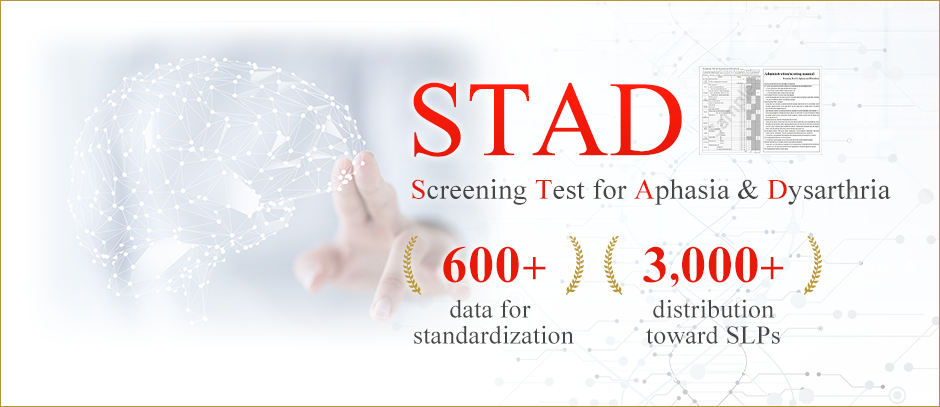

Are you looking for an efficient and reliable tool to screen communicative function?
STAD is designed to support Speech-Language Pathologists (SLPs) in quickly and accurately assessing patients.
"STAD can be used immediately, it is easy to understand and enables us to make decisions for further evaluation."
--- Rin Shibuya (SLP).
STAD 3.0 International Normative Study
Applications are now open for the STAD 3.0 international normative study.
We are inviting licensed, registered, or certified speech-language pathologists / speech and language therapists who are native English speakers to collaborate in collecting normative data for the English version of STAD 3.0.
■Japanese version of STAD is available here
Why Choose STAD?

CREATING THERAPY STRATEGY
Tailored for SLPs
STAD was specifically designed for clinical practice. It is ideal for early bedside assessments, quick summaries of communicative function, or situations where more extensive testing is not feasible.

PROVIDING ACCURATE EVALUATION
Accurate and Reliable
Validated in studies involving over 200 healthy controls and 400 patients, STAD demonstrates strong psychometric properties, ensuring dependable screening results.

SUITABLE FOR EVERYONE
Patient-Friendly
STAD’s simplicity makes it easy to administer, minimizing patient burden and supporting positive interactions with individuals recovering from brain injury.

TRACKING COMMUNICATIVE DISORDERS
Track Progress Over Time
STAD scores can quantify the severity of communicative dysfunction. By plotting scores on a profile sheet, clinicians can visualize changes in patients’ communicative abilities over time.
The best thisn about STAD is that it is
Free for a Limited Time
STAD is currently available completely free of charge, thanks to KAKENHI funding from the Japanese government.
FAQ
Can I use STAD in my clinical setting?
The STAD can be used with any brain injury patient who can open their eyes spontaneously. It is suitable for clinics, hospitals/rehab facilities, and home environments.
I am not familiar with STAD administration, scoring, and interpretation.
STAD consists of simple tasks commonly used in clinical practice. Licensed SLPs can administer STAD without additional expertise. A detailed administration and scoring manual is included with the tool.
I am happy with my current screening method.
STAD provides an additional, validated option to enhance your assessments. Using multiple tools can improve treatment planning, and STAD is available free for a limited time.
Why is STAD free?
Funded by KAKENHI, STAD is offered at no cost. User feedback will support ongoing research and future improvements.
I am not an SLP. Can I use STAD?
STAD is intended for SLPs only. We may expand availability to other medical professionals in the future. Non-medical applications are not accepted at this time.
※ Please note we do not accept applications from those who are not medical experts.
How to
get
STAD
Place an order
Complete the form in “Contact us.”
Download STAD
Once you complete your registration, you’ll be guided to the download link.
Take the training program
Guidance on effective administration will be provided.
Conduct the assessment
Prepare the STAD items and begin assessment immediately.
Benefits of STAD
10minutes
Express administration
Complete screening in approximately 10 m (9 m 48 s on average).
3Objects
Minimal Materials
Only three objects are required. Suitable for a variety of clinical settings.
Q&A
Expert Support
Guidance and Q&A available for all users. Please contact us.
User Testimonials

Ms. Ayumi Uehara (SLP)
STAD reduces patient burden and helps us understand symptoms early. It’s easy to use and becomes even easier with practice.

Ms. Miho Miyasaka (SLP)
STAD ensures consistency in screening, even for less experienced staff, and enhances confidence in patient assessment.
Evidence and Publications
Journals
- Araki K, Hirano Y, Kurita K, Shimizu E. Associations between Non-Verbal Cognitive Assessment and Stroke Recovery via Screening Test for Aphasia and Dysarthria. J Stroke Cerebrovasc Dis. 2025/Feb;34(2):108217. Online ahead of print. https://doi.org/10.1016/
- Araki K, Hirano Y, Kozono M, Fujitani J, Shimizu E. The Screening Test for Aphasia and Dysarthria (STAD) for Patients with Neurological Communicative Disorders: A Large-Scale, Multicenter Validation Study in Japan. Folia Phoniatr Logop. 2021/Sep/10. Online ahead of print. https://doi.org/10.1159/000519381
International conferences
- Kentaro Araki, Kristie Jackson, Masako Fujiu-Kurachi: Cross-Cultural Validation Study of the Screening Test for Aphasia and Dysarthria (STAD). ASHA Convention: Dec 2024, Seattle
- Kentaro Araki, Yoshiyuki Hirano, Kozono Machiko, Eiji Shimizu: Predicting Discharge to Home and Brain Lesions Using the Screening Test for Aphasia and Dysarthria. ASHA Convention: Nov 2021, Washington
- Kentaro Araki, Yoshiyuki Hirano, Kozono Machiko, Eiji Shimizu: Screening Test for Aphasia and Dysarthria and Prediction of Stroke Patients' Discharge to Home. ASHA Convention: Nov 2020, San Diego.
- Kentaro Araki, Yoshiyuki Hirano, Kozono Machiko, Eiji Shimizu: Development of a Worldwide Screening Test for Communicative Disorders Poststroke for International Comparisons. Academy Of
Aphasia: Oct 2019,
Macau. DOI: 10.3389/conf.fnhum.2019.01.00010 - Kentaro Araki, Daisuke Matsuzawa, Machiko Kozono, and Eiji Shimizu: A pilot study for standardizing the screening test for aphasia and dysarthria (STAD). APCSLH: September 2017, Narita.
- Kentaro Araki, Daisuke Matsuzawa, Junko Fujitani, Eiji Shimizu: Development of a screening test for aphasia and dysarthria. ASHA Convention: Nov 2014, Florida.
Books
- Araki, K., Kozono, M., 2018, Screening Test for Aphasia and Dysarthria. Interuna Publishers, Inc. (in Japanese). ISBN-13: 978-4900637542
Current Research Opportunity
The STAD 3.0 international normative study is now open.
If you are a native English-speaking SLP/SLT and are interested in international collaboration, please visit the study page below.
Message
Because we provide the STAD for FREE, we would be grateful if you could consider:
- answering a questionnaire about STAD
- cooperating on future STAD research
And making the STAD more useful and effective for improved clinical practice in the future!