
We are pleased to share an important update on the English STAD project. The university ethics review has been approved, and the project is now moving into its next major phase: a larger-scale normative study. The newly revised STAD 3.0 and its accompanying manual are nearly complete, and we look forward to sharing them with study collaborators.
Revising the STAD 3.0 Manual
We have made major revisions to the STAD 3.0 Manual. Because the upcoming study will involve many SLPs across different settings, we wanted to minimize variability in scoring as much as possible. The manual has therefore been revised in collaboration with an American CCC-SLP to clarify administration and scoring procedures.
One example is the oral diadochokinesis, or DDK, task. The scoring criteria now specify that the syllable sequence should be produced without distortion, with a regular rate and rhythm, and at approximately five or more repetitions per second.
To help examiners internalize what a 5-Hz rhythm sounds like, we have also created a simple reference app. We hope this will help improve scoring consistency across examiners and institutions.
P.S. Try dragging the slider in the demo app — challenge yourself at 8 Hz and see if you can keep pace. In my clinical experience, asking patients to produce syllables in time with the 5-Hz reference beat often leads to a moment of self-awareness:
“Ah, I can really feel how my speech starts to get tangled.”
Why STAD 3.0 Was Revised
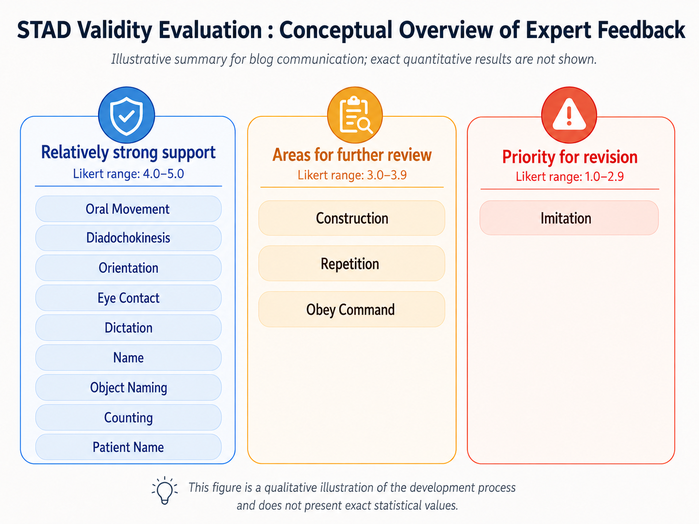
STAD 3.0 has been substantially refined based on our previous validation work, expert feedback, and pilot testing. In our 2024 ASHA presentation, we summarized
expert ratings of STAD and identified several items that required further review or revision. We also conducted pilot studies with healthy adult participants in 2025 and 2026, which revealed
ceiling effects in some parts of the test.
These findings guided the development of STAD 3.0. Our goal was to make the test more sensitive, more clinically useful, and easier to administer in English-speaking contexts.
Example: Revising the Command-Following Task
One important example is the revision of the command-following task. In earlier versions, the commands were relatively simple and often consisted of single-step actions. Based on feedback from native English-speaking SLPs, the task in STAD 3.0 now progresses from simple one-step commands to more complex commands involving multiple steps.
For example:
- “Close your eyes.”
- “Touch your nose, then raise your hand.”
- “Point to the ceiling, touch your ear, and then make a fist.”
By increasing the linguistic and sequential demands in a controlled way, we believe this item now provides a sharper estimate of auditory comprehension. In my own clinical use of the revised version in Japan, I have found that the sensitivity of this item has improved considerably.
Preparing for a Larger-Scale Normative Study
Funding has now been secured to provide honoraria for up to 150 participants. Preparing for this next phase required a long and detailed university approval process, including the ethics review and the arrangement of honorarium payments. We are grateful that this process has now been completed successfully.
Details regarding payment procedures, invoices, and bank transfer documentation will be provided individually.
Moving Forward with SLPs Around the World
After this long period of preparation, we are excited to move forward again with SLPs around the world. Through international collaboration, STAD is now taking its next step toward becoming a screening tool that can be used more widely across languages and cultures.
As a token of our appreciation, collaborators in the upcoming study will receive the newly revised STAD 3.0 and Manual. We hope you will enjoy seeing how the screening has been sharpened and refined through expert feedback, pilot testing, and cross-cultural adaptation.
Recruitment for the next large-scale STAD study is scheduled to begin on July 1, 2026.
We sincerely look forward to your participation.
Kentaro Araki, STAD Project
Write a comment